
Since emerging in May 2023, Rhysida has rapidly risen as a ransomware threat, targeting various sectors in regions around the world. As a ransomware-as-a-service (RaaS) provider, Rhysida offers ransomware to other cybercriminals in exchange for a cut of their ransom profits. Last month, Rhysida perpetrated a devastating cyberattack against the British Library, one of the world’s largest and most prestigious libraries.
The Rhysida attackers exploited a vulnerability in the British Library’s VPN software, which allowed them to bypass a firewall and access the internal network.
Once they gained access to the network, according to a CISA advisory from November 15, the Rhysida gang performed LoLBins techniques. By using these built-in utilities or legitimate applications, they were able to carry out their malicious activities while evading detection. They used:
As a final stage, the attackers deployed the Rhysida ransomware and encrypted millions of the library’s files. They used a “double extortion” technique, demanding a ransom payment of 20 bitcoins (about $590,000) to restore the encrypted data and threatening to publish the sensitive exfiltrated data online unless paid.
The United Kingdom’s national library refused to pay the ransom and later confirmed that some of the personal data had appeared for sale online.
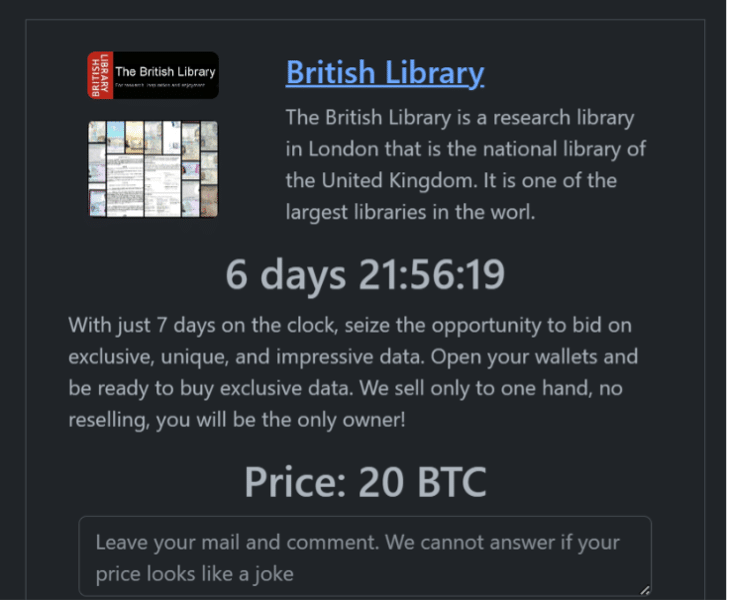
“Open your wallets and be ready to buy exclusive data. We sell only to one hand, no reselling, you will be the only owner!”
Rhysida’s origin and identity are unknown, but some clues suggest that they may be based in Russia, or in the Commonwealth of Independent States, based on the language and time zone of its communications with victims. For example, their ransomware software contains code snippets and comments in Russian, and their ransom notes and leak site use Russian words and phrases. They also avoid attacking organizations in Russia or other former Soviet countries. Rhysida is believed to have links to the Vice Society ransomware group, which was active in 2021 and targeted the education sector. It was even suggested that Rhysida may be using the Vice Society’s ransomware kit or that some of its members may have joined Rhysida after Vice Society stopped operating.
Their main activity is to launch ransomware attacks on a global scale, targeting a diverse range of sectors including education, government, manufacturing, and technology, but with a particular focus on healthcare and public health. Their intercontinental operations have affected organizations in Europe, North and South America, Asia, and Australia.
The Rhysida gang has not only targeted the British Library, but also launched several other high-profile attacks on government and healthcare institutions around the world. Some of their previous victims include:
CISA and the Federal Bureau of Investigation (FBI) have released a joint Cybersecurity Advisory to inform the public about the Rhysida ransomware and its indicators of compromise (IOCs), detection methods, and tactics, techniques, and procedures (TTPs). The federal agencies are also providing assistance to victims and guidance to stop Rhysida ransomware attacks.
Rhysida actors are known for using phishing emails, VPN software and the ZeroLogon vulnerability (CVE-2020-1472) as their initial access vectors. To stay protected, these three steps are recommended:
Cynet customers running the “Best Practice” configuration are protected from the post-exploitation activities of the Rhysida gang by multiple rules and mechanisms.
Search results for: